
Snoring Mouthguards: How They Work, Who They Suit and What to Avoid
Quick Answer: A snoring mouthguard, properly a mandibular advancement splint, is a custom device worn over the teeth that holds the lower jaw gently forward and keeps the airway open, so the tissue stops vibrating. A custom-made one works far better than a chemist boil-and-bite and is a recognised treatment for snoring and mild to moderate sleep apnoea. It suits the right patient, decided with your GP or sleep physician, not everyone.
Snoring mouthguards attract more scepticism than anything else I do, usually from people whose only experience is a bulky boil-and-bite from the chemist that lasted three nights before it was banished to a drawer. The proper version is a different instrument altogether. It is called a mandibular advancement splint, or MAS, and it is the treatment I chose for myself: I have obstructive sleep apnoea, I could not tolerate CPAP, and a custom appliance is the reason I wake up rested. I am Dr Andre Schertel, Dentist, and I fit these appliances at Peninsula Snore Clinic in Mt Eliza. Here is what they are, what the evidence actually says, and how to avoid spending money on the wrong one.
What a Snoring Mouthguard Actually Is
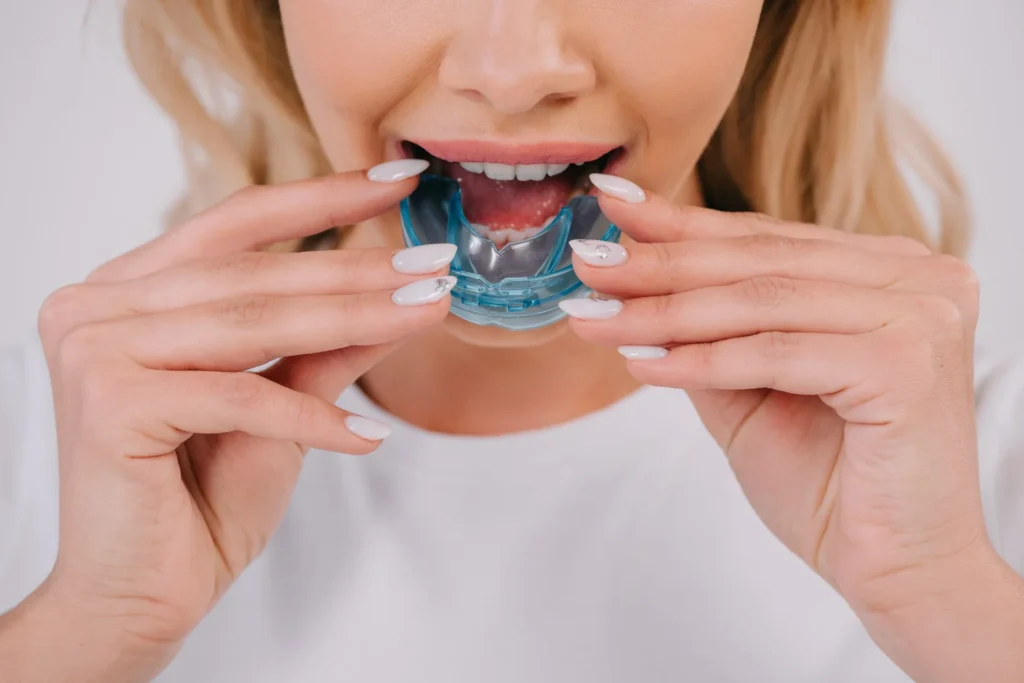
A snoring mouthguard worth the name is a custom-made medical appliance, not a piece of moulded plastic. It is a slim two-part device that fits over your upper and lower teeth. During sleep it holds your lower jaw slightly forward, which carries the base of the tongue forward with it, opens the airway behind it, and stops the soft tissue vibration that makes the noise. [1]
You will see the same device called an oral appliance, a mandibular advancement splint, a mandibular repositioning device or an anti-snoring mouthpiece. The names matter less than two properties: it must fit your teeth precisely, and it must be titratable, meaning the forward position can be adjusted in small steps until your snoring is controlled. [2]
The appliances we fit are custom-made by dedicated dental sleep laboratories, including SomnoMed, O2Vent and 3D Sleep among others, from a digital scan of your own teeth, and I match the design to your teeth, jaw and needs rather than fitting everyone the same device. It is a different category of device from anything sold one-size-fits-most, and the evidence below shows why that distinction matters.
Do Snoring Mouthguards Work?
For snoring itself, the joint clinical practice guideline of the American Academy of Sleep Medicine and the American Academy of Dental Sleep Medicine found that oral appliances cut snoring frequency by nearly two nights per week. [2] For obstructive sleep apnoea, across 34 randomised trials in 1,301 patients, they reduced the apnoea-hypopnoea index by an average of 13.6 events per hour. [2]
The comparison everyone asks about is CPAP, and the honest answer has two halves. On a sleep study, CPAP is more efficacious, and for severe sleep apnoea it should be tried first, with an appliance considered when CPAP fails or cannot be tolerated. But a treatment only works while it is being used, and oral appliances tend to be worn for more of the night than masks. That adherence advantage can offset the efficacy gap, so overall effectiveness for the right patient can end up comparable. [3]
The right patient is the key phrase. Appliances are a recognised option for primary snoring and for mild to moderate sleep apnoea, with the decision made together with your GP or sleep physician rather than off your own bat. [2]
Custom vs Ready-Made Snoring Mouthguards
People make an expensive mistake in this category in both directions: buying cheap and failing, or assuming the custom version is the same thing with a professional margin added.
A randomised clinical trial put the two head to head. The custom-made device achieved a complete treatment response in 64% of participants. The ready-made device managed 24%, and 36% of its users were outright treatment failures compared with 4% for custom. Participants also wore the custom device more nights per week and more hours per night. [4] The clinical guideline reaches the same conclusion and recommends a custom, titratable appliance over non-custom devices. [2]
The difference comes down to retention and adjustability. A device made from records of your own teeth grips securely, can be advanced a fraction of a millimetre at a time, and can be adjusted around your dental work. A boil-and-bite grips approximately, advances approximately, and forgives nothing. If it falls out at 2 am or hurts by night three, it stops being a treatment at all.
Side Effects, Told Straight
No effective treatment is free of trade-offs, and you should hear them before you commit. Early on, most people notice extra saliva or a dry mouth, tender teeth or jaw muscles, and a bite that feels odd for a while in the morning. These are usually mild and settle. [2] Over years of use there can be small permanent changes to the bite, measured as reductions in overjet and overbite. [2]
This is why a snoring mouthguard is a supervised dental treatment rather than a product. Before we start, I examine your jaw joints as well as your teeth and gums to confirm you are suited to one. At every review I monitor your bite, so any change is picked up early and discussed openly rather than discovered years later.
Who Suits One, and Who Does Not
I look for four things before recommending a snoring mouthguard: enough sound teeth to anchor it, healthy gums, jaw joints that will comfortably tolerate holding a forward posture overnight, and a diagnosis that fits, meaning confirmed snoring or mild to moderate sleep apnoea. [2]
An appliance is usually the wrong answer when teeth are too few or too mobile, when gum disease is active, when a jaw joint disorder makes the forward posture unwise, or when sleep apnoea is severe and CPAP has not been properly tried. Sometimes the nose needs attention before any mouthguard can do its best work. If any of that describes you, I will say so at the assessment, because fitting an appliance that should not have been fitted helps nobody.
Getting a Snoring Mouthguard on the Mornington Peninsula
The pathway is deliberately unexciting. Diagnosis comes first: sleep apnoea can only be ruled in or out with a sleep study arranged through your GP or a sleep physician, not from symptoms, questionnaires or an app. [5] If you already have a sleep study report, bring it to your first visit.
At the clinic, the first appointment is a conversation and an examination: your sleep history, your health, then your teeth, gums, jaw joints and airway. If an appliance is appropriate, we take precise records of your teeth and your device is custom-made for you. At the fitting you learn how to use and care for it, and over the following reviews we advance it gradually until the snoring is controlled, keeping your GP or sleep physician in the loop throughout.
Peninsula Snore Clinic is at 1299 Nepean Hwy, Mt Eliza. We see patients from across the Mornington Peninsula, Bayside, Western Port and Frankston, including Mornington, Mount Martha, Rosebud and Seaford, and you can reach us on 03 9775 4600.
Where a Mouthguard Fits in the Bigger Picture
An appliance is not the only lever. Weight, evening alcohol, sleeping position and a blocked nose all change how much you snore, and I cover those properly in my guide on how to stop snoring. But if your research has narrowed to snoring mouthguards, the evidence points one way: custom-made, properly fitted, adjusted over time and reviewed by someone accountable for the result, and that is the only kind we provide.
This article is general information only and is not a substitute for individual medical or dental advice. If you are concerned about your sleep or breathing, please speak with your GP. Individual results vary and a thorough assessment is recommended before beginning any treatment.
Frequently Asked Questions: Snoring Mouthguards
Do snoring mouthguards really work?
For snoring, oral appliances cut snoring frequency and events substantially, and across many trials they reduce the apnoea-hypopnoea index by an average of about 13.6 events per hour. They work best for the right patient, decided with your GP or sleep physician.
How much does a snoring mouthguard cost?
At my clinic a custom device is typically $2,000 to $2,500, all-inclusive, with private health rebates often available under dental item 984. I cover this in detail in my guide on the snoring mouthguard cost.
Custom or chemist: does it matter?
It matters a lot. In a randomised trial the custom device achieved a complete response in 64% of patients against 24% for the ready-made one, and it was worn more. A boil-and-bite that falls out or hurts stops being a treatment.
Are there side effects?
Early on, most people notice extra saliva or a dry mouth, tender teeth or jaw muscles, and a bite that feels odd for a while in the morning. These are usually mild. Over years there can be small bite changes, which is why it is a supervised dental treatment.
Who should not use a snoring mouthguard?
It is usually the wrong answer when there are too few or too mobile teeth, active gum disease, a jaw joint disorder that makes holding the jaw forward unwise, or severe sleep apnoea where CPAP has not been properly tried. I will tell you at the assessment.
References
[1] Saha S, et al. A subject-specific acoustic model of the upper airway for snoring sounds generation. Scientific Reports. 2016;6:25730. https://www.nature.com/articles/srep25730
[2] Ramar K, et al. Clinical practice guideline for the treatment of obstructive sleep apnea and snoring with oral appliance therapy: an update for 2015. Journal of Clinical Sleep Medicine. 2015;11(7):773-827. https://aasm.org/resources/clinicalguidelines/oral_appliance-osa.pdf
[3] Sutherland K, et al. Oral appliance treatment for obstructive sleep apnea: an update. Journal of Clinical Sleep Medicine. 2014;10(2):215-227. https://pmc.ncbi.nlm.nih.gov/articles/PMC3899326/
[4] Johal A, et al. Ready-made versus custom-made mandibular repositioning devices in sleep apnea: a randomized clinical trial. Journal of Clinical Sleep Medicine. 2017;13(2):175-182. https://pmc.ncbi.nlm.nih.gov/articles/PMC5263072/
[5] Kapur VK, et al. Clinical practice guideline for diagnostic testing for adult obstructive sleep apnea: an American Academy of Sleep Medicine clinical practice guideline. Journal of Clinical Sleep Medicine. 2017;13(3):479-504. https://aasm.org/resources/clinicalguidelines/diagnostic-testing-osa.pdf