
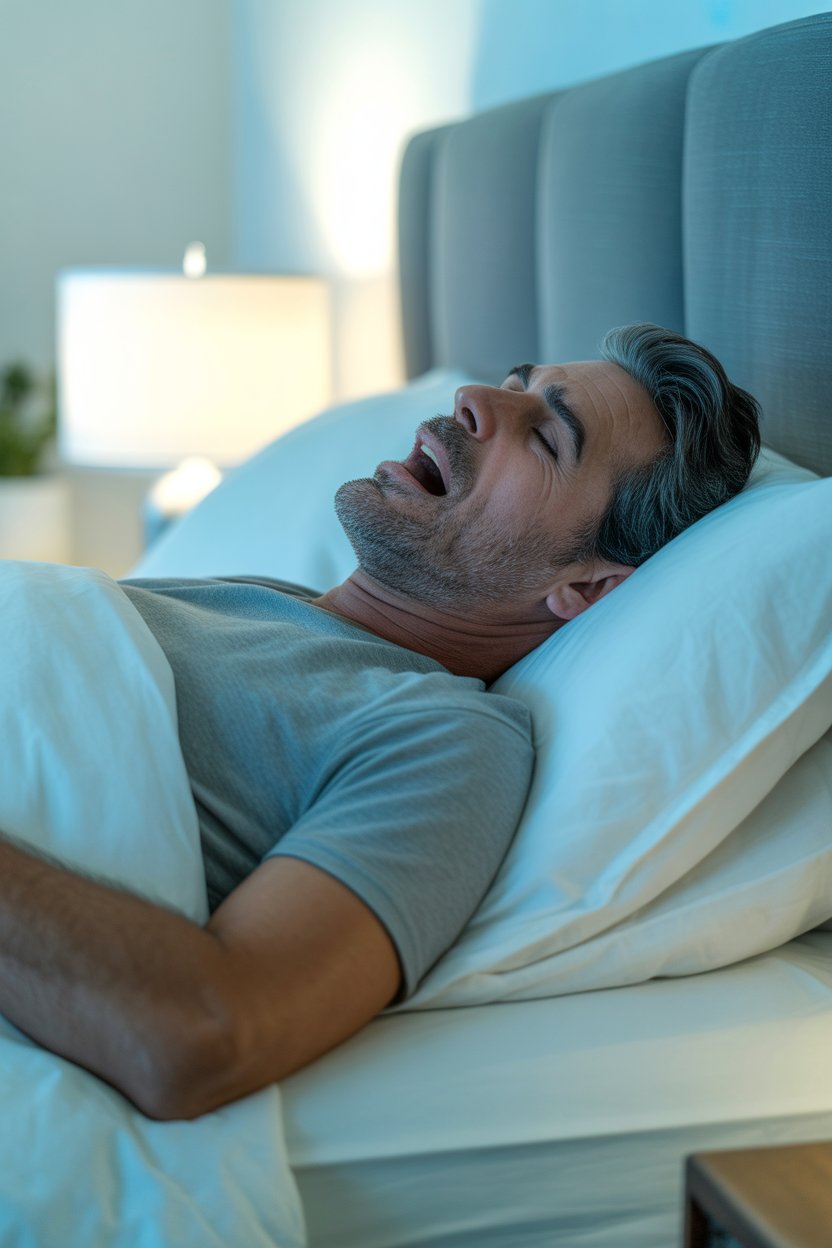
Waking Up Gasping or Choking: What It Means
Quick Answer: Waking up gasping for air is one of the clearest warning signs of obstructive sleep apnoea. It usually means the airway closed during sleep and you woke to reopen it. It is worth taking seriously, but it is not proof on its own, because reflux, anxiety and a blocked nose can do the same thing. The way to know is a sleep study arranged through your GP.
Waking up gasping for air is frightening. One moment you are asleep, the next you are sitting up with your heart pounding, short of breath, not sure what just happened. It usually settles in a few seconds, and by morning it is easy to talk yourself out of worrying about it. I would not. I am Dr Andre Schertel, Dentist, at Peninsula Snore Clinic in Mt Eliza. Of all the signs of obstructive sleep apnoea, this is one of the clearest, and it deserves a proper look.
What is happening when you wake gasping
In obstructive sleep apnoea, the airway at the back of the throat narrows and collapses during sleep. The soft tissue relaxes, the airway closes, and air can no longer get through [1]. Your body notices the drop in oxygen and the rising effort to breathe, and it does the only thing it can. It wakes you, just enough to tense the muscles and pull the airway open again. That is the gasp or the choke. You take a big breath, the airway opens, and you fall back to sleep.
The unsettling part is how often this can happen without you remembering it. Most of these wakes are so brief that you have no memory of them in the morning. Waking up gasping for air is simply the time it broke through into consciousness. For every one you remember, there may be many that you do not. That is why the person most likely to notice is whoever sleeps next to you. They hear the snoring, then the silence, then the gasp.
Why it is worth taking seriously
I do not want to frighten anyone, but I also will not soften this. Untreated obstructive sleep apnoea is not just about being tired. It is linked with serious health problems over time, including high blood pressure, heart disease and other cardiovascular conditions [2]. The repeated drops in oxygen and the constant stirring from sleep put strain on the heart and blood vessels night after night.
That is the reason a gasping arousal is worth acting on rather than ignoring. Not because one bad night is dangerous, but because a pattern of them, over months and years, is doing quiet damage. The better news is that it is very treatable once it is diagnosed. The step that matters is getting it looked at.
It is not always sleep apnoea
Waking up gasping for air is a strong pointer to sleep apnoea, but it is not the only cause, and I would not want you to self diagnose either way.
A few other things can wake you short of breath. Acid reflux can rise into the throat while you are lying down and cause a choking, coughing wake, often with a sour taste or a burning chest. Anxiety and panic can cause a sudden breathless waking, sometimes with a racing heart. A very blocked nose, from a cold or hay fever, can do it. Less commonly, heart and lung conditions can cause breathlessness at night, which is one reason this is worth a proper medical look rather than a guess.
The way to tell these apart is not the feeling in the moment, because they can feel similar. It is the pattern, the other signs, and ultimately a proper assessment.
What to do about it
If you are waking up gasping for air, here is the practical path.
First, gather what you can. If you have a partner, ask them what they see and hear. Loud snoring most nights, silences where you seem to stop breathing, and then a gasp or a snort, is the classic pattern. Ask whether they have noticed it. Their account is often more useful than yours, because you are asleep for the part that matters.
Note the other signs too. Waking unrefreshed, daytime sleepiness, morning headaches, waking to pass urine, poor concentration or a short temper. The more of these that fit, the stronger the case.
Then see your GP. Describe the gasping and everything else, honestly. Your GP can arrange the next step, which is a sleep study. This is the only way to confirm obstructive sleep apnoea. National guidelines are clear that it should not be diagnosed on symptoms alone, without this kind of testing [3]. I want to be straight that we do not run sleep studies at the clinic. They are arranged through your GP or a sleep physician, and I work from the results.
What treatment looks like
Treatment depends on what the sleep study shows.
For severe obstructive sleep apnoea, CPAP is the first line treatment. It is a machine that keeps the airway open with a gentle flow of air through a mask, and it is very effective at stopping the collapses and the gasping.
For snoring and for mild to moderate sleep apnoea, or for people who cannot tolerate CPAP, a custom oral appliance is a well evidenced option [4]. It is a device worn in the mouth at night that holds the lower jaw slightly forward to help keep the airway open. That is the part I handle.
I have obstructive sleep apnoea myself. I could not tolerate CPAP, and a custom appliance is what worked for me, so I understand why people look for an alternative. It does not suit everyone, and results vary from person to person, but for the right person it makes a real difference. My training in this area is the Fellowship of Dental Sleep Medicine.
Where I fit in
Once you have a diagnosis, bring the report to Peninsula Snore Clinic and we plan from there. If a custom oral appliance suits you, we take a digital scan of your teeth rather than using putty, and I match the design to your teeth and jaw from a range of appliances rather than fitting everyone with the same one. The all-inclusive fee is $2,000 to $2,500, which covers the assessment, the scan, the custom device, the fitting and every adjustment and review through the first 12 months. We process HICAPS claims on the spot, we accept DVA, TAC and Worksafe, and payment plans are available.
We are at 1299 Nepean Highway, Mt Eliza, serving the Mornington Peninsula, Bayside, Western Port and Frankston. You can read more in my guide on snoring mouthguards, and about the test itself in my guide on what a sleep study involves. If you are waking up gasping for air more than the odd time, please do not wait it out. See your GP, get it checked, and let us help with the treatment if a splint turns out to suit you.
Frequently Asked Questions
Is waking up gasping for air a sign of sleep apnoea?
It is one of the clearest signs. It usually means the airway closed during sleep and you woke to reopen it, which is exactly what happens in obstructive sleep apnoea [1]. It is not proof on its own, because reflux, anxiety and a blocked nose can cause a similar waking, so it needs proper assessment rather than self diagnosis.
Should I be worried if I wake up choking at night?
One episode now and then is not an emergency, but a pattern of it is worth acting on. Untreated obstructive sleep apnoea is linked with high blood pressure and other cardiovascular problems over time [2]. That is a reason to get it checked, not to panic. See your GP and describe what is happening.
What else can cause waking up gasping for air?
Acid reflux rising into the throat, anxiety or panic, and a very blocked nose from a cold or hay fever can all wake you short of breath. Less commonly, heart and lung conditions can too, which is one reason a proper medical assessment matters rather than assuming it is sleep apnoea or assuming it is nothing.
How is sleep apnoea diagnosed?
Through a sleep study, which measures your breathing, oxygen levels and how often your sleep is disturbed overnight. Guidelines are clear that sleep apnoea should not be diagnosed on symptoms alone [3]. It is arranged through your GP or a sleep physician. We do not run sleep studies at our clinic; I work from the results.
What is the treatment if I do have sleep apnoea?
For severe sleep apnoea, CPAP is the first line treatment. For snoring and mild to moderate sleep apnoea, or for people who cannot tolerate CPAP, a custom oral appliance that holds the lower jaw slightly forward is a well evidenced option [4]. It does not suit everyone and results vary, so the right choice depends on your diagnosis.
This article is general information only and is not a substitute for individual medical advice. Obstructive sleep apnoea can only be diagnosed through a sleep study arranged by your GP or a sleep physician, not at our clinic. If you are waking up breathless, choking or with chest pain, or you are worried about your heart or breathing, please see a doctor promptly. Individual results vary, and a mandibular advancement splint is not suitable for everyone.
References
[1] Saha S, et al. A subject-specific acoustic model of the upper airway for snoring sounds generation. Scientific Reports. 2016;6:25730. https://www.nature.com/articles/srep25730
[2] Yeghiazarians Y, et al. Obstructive sleep apnea and cardiovascular disease: a scientific statement from the American Heart Association. Circulation. 2021;144(3):e56-e67. https://www.ahajournals.org/doi/10.1161/CIR.0000000000000988
[3] Kapur VK, et al. Clinical practice guideline for diagnostic testing for adult obstructive sleep apnea: an American Academy of Sleep Medicine clinical practice guideline. Journal of Clinical Sleep Medicine. 2017;13(3):479-504. https://aasm.org/resources/clinicalguidelines/diagnostic-testing-osa.pdf
[4] Ramar K, et al. Clinical practice guideline for the treatment of obstructive sleep apnea and snoring with oral appliance therapy: an update for 2015. Journal of Clinical Sleep Medicine. 2015;11(7):773-827. https://aasm.org/resources/clinicalguidelines/oral_appliance-osa.pdf